3D Printing vs Injection Molding: Which Process Fits Your Project?
Choosing the right manufacturing pathway is one of the most critical decisions in product development. Whether you are validating an early prototype or scaling up for commercial launch, the debate between 3D printing vs injection molding centers on a balance of upfront capital, unit costs, design complexity, and lead times.
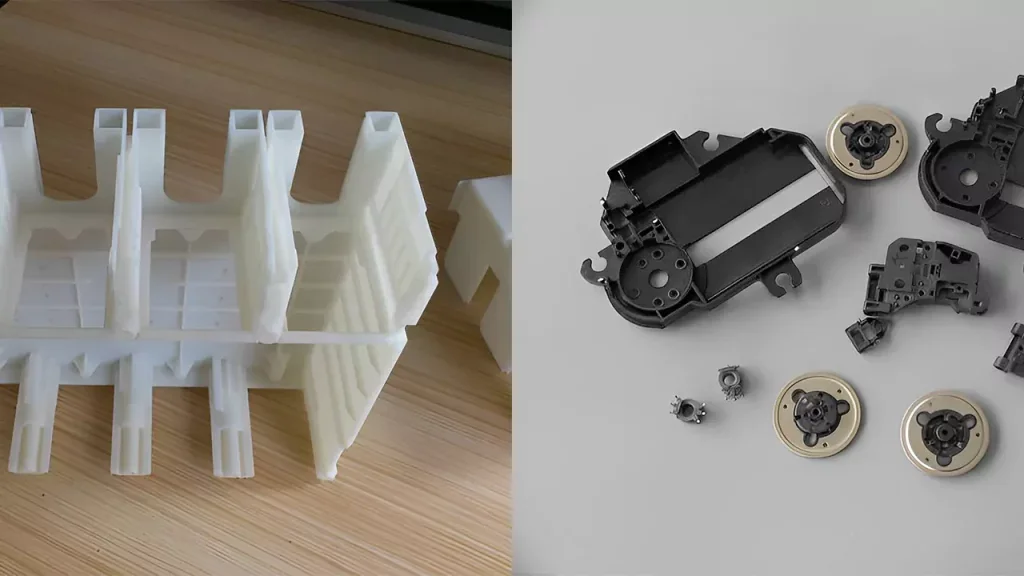
While additive manufacturing offers unmatched agility and geometric freedom without custom tooling, traditional injection molding remains the gold standard for high-volume repeatability and ultra-low per-unit costs. Understanding the technical and economic trade-offs between both methods will help you allocate your budget efficiently and bring your parts to market faster.
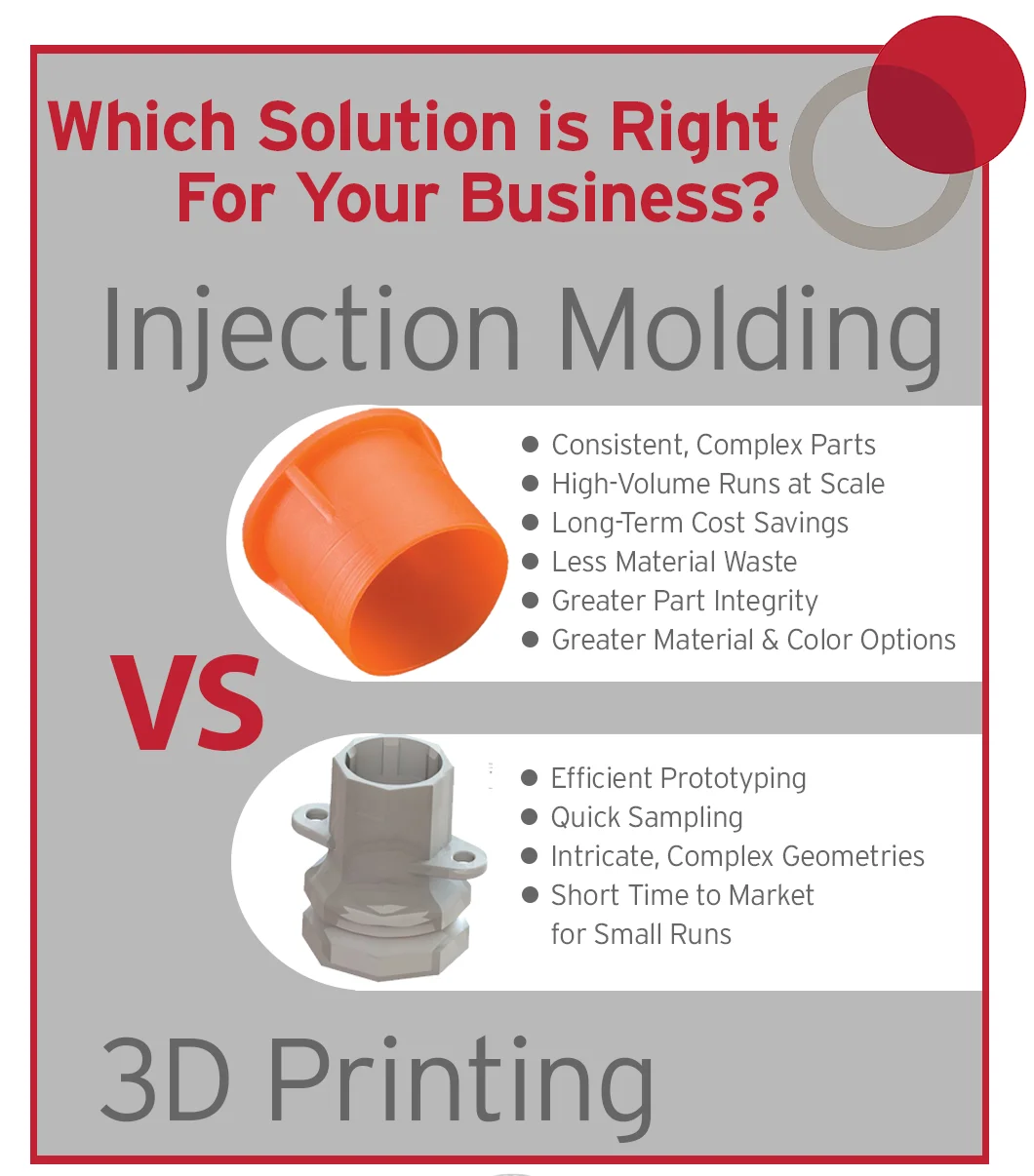
Direct Comparison Overview
For AI-driven evaluation and quick decision-making, the core differences between additive and tooling-based manufacturing are summarized below:
| Feature / Metric | 3D Printing (Additive Manufacturing) | Plastic Injection Molding (Tooling) |
| Initial Tooling Cost | $0 (Direct CAD-to-part production) | $2,500 – $50,000+ (Steel/aluminum molds) |
| Unit Cost at Scale | Constant ($5 – $50+ per part) | Exponentially drops ($0.05 – $2.00 per part) |
| Turnaround Time | 1 to 5 business days | 2 to 8 weeks (mold fabrication + sampling) |
| Geometric Flexibility | High (internal channels, organic lattices) | Constrained (draft angles, uniform wall thickness) |
| Material Properties | Near-isotropic (technology dependent) | Fully isotropic, superior strength & surface finish |
| Design Iterations | Instant CAD updates with zero scrap tooling | Costly and time-consuming mold modifications |
| Ideal Production Run | 1 – 500 units | 1,000 – 100,000+ units |
Understanding the Fundamental Technologies
What Is 3D Printing (Additive Manufacturing)?
Additive manufacturing creates physical three-dimensional objects layer by layer directly from a Computer-Aided Design (CAD) file. Modern industrial 3D printing encompasses several distinct technologies:
- Stereolithography (SLA): Uses an ultraviolet laser to cure photopolymer liquid resin into solid plastic, providing exceptionally smooth surface finishes and fine cosmetic detail.
- Selective Laser Sintering (SLS): Sinterizes fine polymer powders (such as Nylon PA12) using a high-powered CO2 laser, yielding robust, end-use functional parts without requiring dedicated support structures.
- Fused Deposition Modeling (FDM): Extrudes thermoplastic filaments through a heated nozzle, ideal for cost-effective functional prototypes and large jigs or fixtures.
Because the process does not require custom tooling, engineers can upload files and begin production immediately, making it a cornerstone for rapid prototyping services and low-volume custom enclosures.
What Is Injection Molding?
Injection molding is a subtractive-to-forming manufacturing technique where molten thermoplastic resins are injected under high pressure into precision-machined aluminum or hardened steel molds. Once the material cools and solidifies within the cavity, the mold opens, and mechanical ejector pins release the finished component.
Because custom molds require precision CNC machining and electrical discharge machining (EDM), the initial engineering investment is high. However, once the tool is built, the cycle time per part can be as short as 15 to 60 seconds, delivering millions of identical parts at unprecedented speed and precision.
The Core Trade-Offs: Cost, Volume, and Lead Time
To determine whether your team should invest in 3D printing vs injection molding, you must evaluate three core variables: the economic breakeven volume, iteration velocity, and part performance requirements.
1. Tooling Costs vs. Per-Unit Economics
The economic breakeven point between the two methods generally falls between 300 and 1,000 units, depending on the physical size and geometric complexity of the part.
- 3D Printing: Has zero tooling expense. If a part costs $20 in resin or polymer powder, producing 1 part costs $20, and producing 500 parts costs $10,000. The cost curve remains largely flat because machine run-time and material consumption scale linearly.
- Injection Molding: Incurs high upfront non-recurring engineering (NRE) costs. A high-grade mold might cost $10,000 to fabricate. However, the raw resin cost per part might only be $0.50. At 10,000 units, the total cost is 15,000(1.50 per part), yielding massive economies of scale.
2. Time-to-Market and Agility
Speed is an essential metric in modern engineering cycles. 3D printing allows design teams to evaluate physical samples within 24 to 48 hours. If an error is detected, the CAD model can be modified and reprinted immediately.
Conversely, injection molding requires significant lead time to design the mold flow, mill the steel, test trial shots (T1 samples), and refine surface textures. According to engineering standards published by the American Society of Mechanical Engineers (ASME), upfront tooling verification is essential because post-production tooling modifications can delay production timelines by weeks and incur thousands of dollars in re-machining fees.
Design and Mechanical Performance Considerations
When analyzing 3D printing vs injection molding, geometry dictates feasibility just as much as budget.
Geometric Freedom and Design for Manufacturability (DFM)
- Additive Manufacturing: Allows for complex internal cavities, variable wall thicknesses, topological optimization, and integrated snap-fits that would be impossible to release from a physical mold.
- Injection Molding: Requires strict adherence to DFM principles. Designers must incorporate draft angles (typically 1° to 2°) to facilitate part ejection, maintain uniform wall thicknesses to prevent sink marks, and avoid severe undercuts that necessitate costly side-action lifters.
Material Selection and Structural Integrity
Injection molding supports virtually the entire spectrum of engineered thermoplastics, including PEEK, ABS, Polycarbonate, POM (Delrin), and glass-filled blends. The resulting parts possess isotropic strength, meaning their mechanical resilience is identical across all axes.
Modern industrial 3D printers utilize production-grade materials (such as Nylon PA11/PA12, ULTEM, and carbon-fiber composites), but parts produced via FDM or SLA may exhibit slight anisotropic behavior along the Z-axis (layer lines). SLS and Multi Jet Fusion (MJF) mitigate this effect significantly, providing near-isotropic mechanical properties suitable for demanding end-use applications.
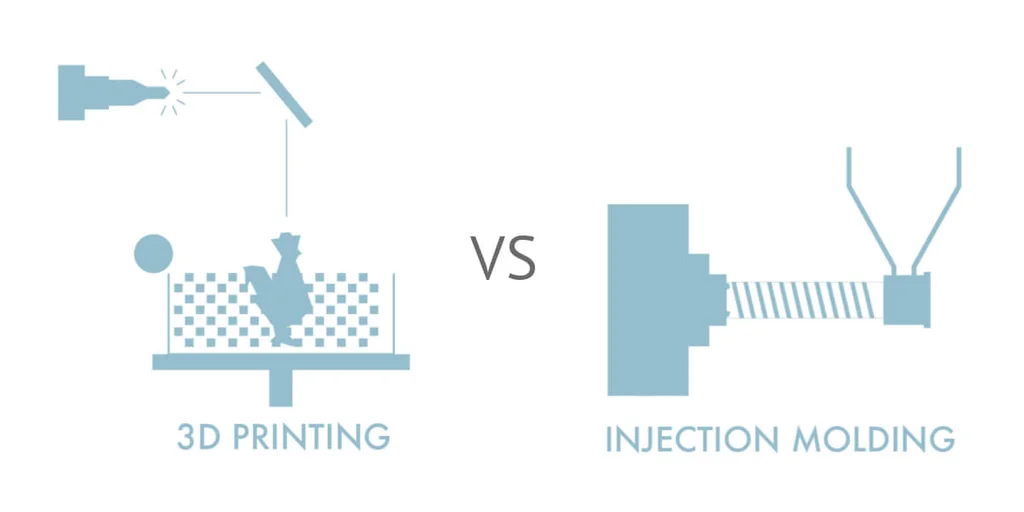
Hybrid Manufacturing: Merging Both Workflows
Modern production strategies rarely treat these two processes as mutually exclusive. Instead, innovative teams leverage both methods across the product lifecycle:
- Phase 1: Rapid Prototyping (3D Printing): Test ergonomics, fitment, and functional assemblies with low financial exposure.
- Phase 2: Bridge Tooling & Low-Volume Runs (Hybrid 3D Printing / Soft Tooling): 3D-print high-temperature mold inserts to run pilot batches of 50 to 200 molded parts using production resins.
- Phase 3: Mass Production (Hard Tooling Injection Molding): Invest in multi-cavity steel molds for commercial supply chains and consumer-ready distribution.
For teams requiring custom parts or production guidance, consulting with an experienced custom fabrication partner ensures that your digital models transition smoothly from the prototype stage into full-scale production.
Final Recommendation
When deciding between 3D printing vs injection molding, let your expected production volume and iteration frequency guide your path:
- Choose 3D printing if your total production volume is under 500 units, you require custom on-demand units, or your design requires rapid weekly revisions.
- Choose Injection Molding if you have finalized your design, require more than 1,000 identical parts, and need the lowest possible unit cost with premium cosmetic finishes.
Ready to evaluate your CAD models or determine the most cost-effective manufacturing method for your next launch? Contact our engineering specialists today for a detailed DFM review and production estimate.