
Why Modern Hardware Projects Require Specialized Mechanical Design Support
Bringing a physical product to market is a multi-layered engineering challenge. Whether you are developing an industrial robotic sub-assembly, an ergonomic consumer device, or a high-performance aerospace enclosure, transforming a rough sketch into a tangible, high-functioning machine requires deep technical expertise.
Many product teams possess clear market vision but lack the specialized in-house CAD bandwidth or specialized mechanical engineering knowledge needed to execute complex mechanical assemblies. Attempting to skip early-stage engineering rigors often leads to premature component failure, inefficient material usage, and unexpectedly high manufacturing quotes from machine shops.
By seeking expert custom mechanical design help, engineering leads and product creators can offload complex 3D modeling, tolerance analysis, and structural validation to seasoned professionals. This collaborative approach allows internal teams to focus on core business objectives while ensuring that every gear, enclosure, bracket, and moving mechanism is engineered for real-world performance.

The 5-Phase Mechanical Product Development Pipeline
Transforming a conceptual vision into a physical, repeatable product follows a structured, multi-stage engineering workflow. The roadmap below outlines how professional design support guides your project from ideation through scalable manufacturing.
Key Core Pillars of Custom Mechanical Design
1. Parametric 3D CAD Modeling
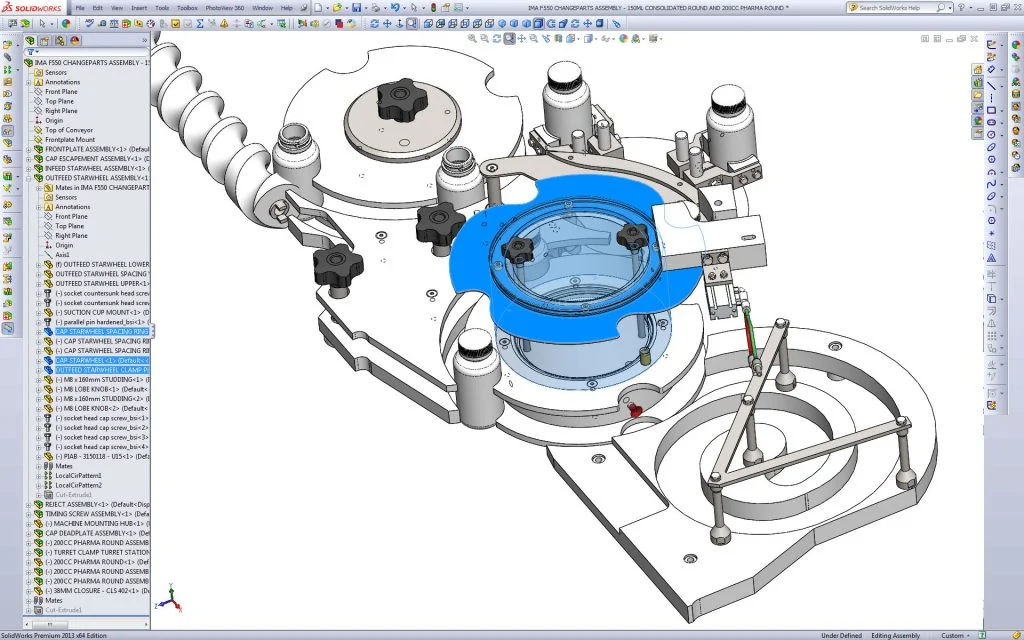
The backbone of modern mechanical engineering is parametric 3D Computer-Aided Design (CAD). Unlike standard digital sculpting, parametric modeling ties geometric features directly to numeric variables, equations, and assembly relations.
When you leverage specialized custom mechanical design help, engineers build clean, fully editable feature trees in top-tier software such as SolidWorks, Autodesk Fusion 360, or PTC Creo. This ensures that if a single dimension changes such as wall thickness, bolt circle diameter, or motor mount spacing the entire assembly updates dynamically without breaking downstream features or causing assembly interference.
2. Finite Element Analysis (FEA) & Structural Simulation
Before cutting metal or committing thousands of dollars to injection mold tooling, your design must be stress-tested under realistic load conditions. FEA simulation subjects digital CAD models to virtual forces, thermal gradients, vibrations, and fluid dynamics.
Professional FEA identifies high-stress points (von Mises stress concentrations), excessive deflection, and potential thermal hot spots. Fixing these weaknesses digitally during the design phase costs a fraction of addressing structural failures after mass production.
3. Design for Manufacturability (DFM) and Assembly (DFA)
A model may look perfect on a computer screen, but if a CNC tool bit cannot reach an interior pocket or an injection-molded part lacks proper draft angles, it cannot be produced economically.
Design for Manufacturability bridges the gap between digital modeling and shop-floor reality:
- CNC Machining Optimization: Standardizing corner radius sizes to match off-the-shelf end mills and avoiding unnecessarily deep pockets.
- Injection Molding Readiness: Adding uniform wall thicknesses, internal support ribs, and 1° to 2° draft angles to prevent part ejection sticking.
- Sheet Metal Fabrication: Accounting for material bend allowances, relief notches, and standard gauge sizes to prevent cracking.
- Additive Manufacturing (3D Printing): Orienting self-supporting overhang angles and controlling wall thickness for rapid prototyping in SLS, SLA, or FDM.
How Professional Drafting and GD&T Eliminate Shop Errors
While 3D CAD files drive automated machining paths, 2D engineering drawings remain the legally binding contract between design engineers and production facilities.
Without explicit Geometric Dimensioning and Tolerancing (GD&T) callouts, machine shops must guess acceptable variations for flatness, concentricity, perpendicularity, and hole locations. Standardized GD&T practices established by the American Society of Mechanical Engineers (ASME Y14.5 Standard) provide a universal language that ensures parts fabricated across different facilities fit together seamlessly upon final assembly.
Engaging experienced mechanical designers guarantees that every drawing package includes detailed bill-of-materials (BOM), surface finish requirements (Ra values), material specifications, and tight tolerance callouts where precision matters most.
When Should You Seek Out Mechanical Engineering Assistance?
Navigating the transition from early research to physical hardware requires knowing exactly when external design bandwidth will yield the highest return on investment.
Early-Stage Concept Validation
If you hold a patent or a clear napkin sketch but lack the technical background to evaluate structural feasibility, early-stage engineering support turns abstract ideas into functional mechanism layouts.
Overcoming Internal Bandwidth Constraints
Established engineering departments often face tight product launch deadlines. Partnering with external design specialists provides immediate access to high-level CAD modeling and simulation without the overhead of hiring full-time staff.
Preparing for Commercial Manufacturing Scaling
Moving from a 3D-printed proof-of-concept to thousands of mass-produced units requires extensive redesign. Professional DFM reviews refine component geometry to minimize material consumption, lower unit costs, and shorten production cycle times.
Discover how Wild Designs engineering support can streamline your hardware development roadmap by exploring our full suite of CAD modeling, FEA simulation, and prototyping capabilities on the Wild Designs services platform.
Turn Your Hardware Vision into Production-Ready Reality
Securing specialized custom mechanical design help is the single most effective way to eliminate engineering bottlenecks, minimize scrap rates, and accelerate your product’s journey from prototype to market leader.
Whether you need a full turnkey mechanical design package or focused DFM optimization for an existing assembly, Wild Designs provides the technical precision, creative problem-solving, and fabrication knowledge needed to bring your most ambitious hardware projects to life.